Every SaaS app ships a terms of service. Nobody reads it. The usual approach is a Google Doc pasted into a static page — no context, no explanation, just wall-of-text legalese that users click through on autopilot.
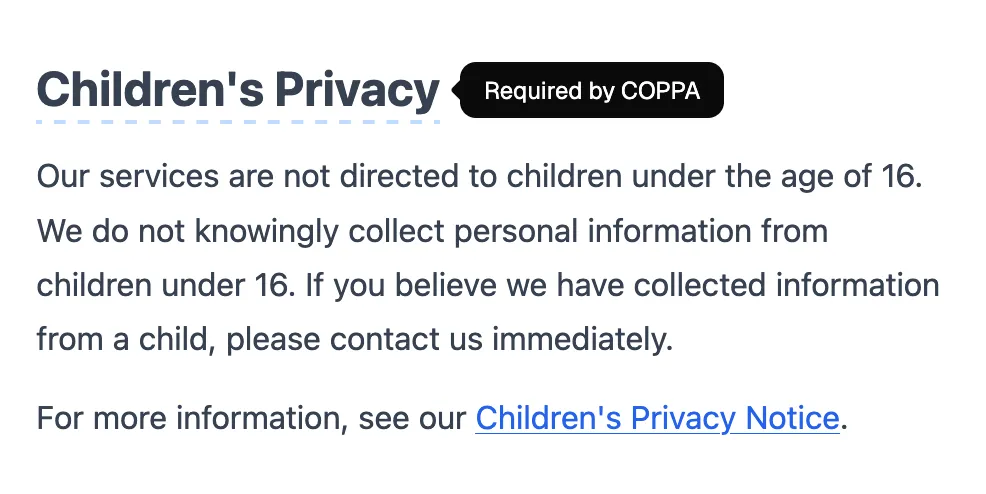
OpenPolicy generates your ToS as a structured document tree, not raw HTML. Each heading and paragraph carries a context.reason — a plain-English note explaining why that clause exists. Pair it with shadcn’s Tooltip and you get a terms page that actually teaches users what they’re agreeing to.
Install
bun add @openpolicy/sdk @openpolicy/react
# then add shadcn tooltip
bunx shadcn@latest add tooltip
Define your terms
Create an openpolicy.ts at the root of your project and fill in the terms block:
// openpolicy.ts
import { defineConfig } from "@openpolicy/sdk";

export default defineConfig({
  company: {
    name: "Acme",
    legalName: "Acme, Inc.",
    address: "123 Main St, San Francisco, CA 94105",
    contact: "legal@acme.com",
  },
  terms: {
    effectiveDate: "2026-03-19",
    acceptance: {
      methods: ["using the service", "creating an account"],
    },
    eligibility: {
      minimumAge: 13,
    },
    accounts: {
      registrationRequired: true,
      userResponsibleForCredentials: true,
      companyCanTerminate: true,
    },
    prohibitedUses: [
      "Violating any applicable laws or regulations",
      "Attempting to gain unauthorized access to any part of the service",
      "Transmitting malware or malicious code",
    ],
    intellectualProperty: {
      companyOwnsService: true,
      usersMayNotCopy: true,
    },
    disclaimers: {
      serviceProvidedAsIs: true,
      noWarranties: true,
    },
    limitationOfLiability: {
      excludesIndirectDamages: true,
      liabilityCap: "the amount paid by the user in the past 12 months",
    },
    governingLaw: {
      jurisdiction: "Delaware, USA",
    },
    changesPolicy: {
      noticeMethod: "email or prominent notice on the website",
      noticePeriodDays: 30,
    },
  },
});
The context.reason field
When OpenPolicy compiles your config into a document tree, it attaches plain-English reasoning to every heading it generates. The HeadingNode type (from @openpolicy/core) looks like this:
export type NodeContext = {
  reason?: string;
};

export type HeadingNode = {
  type: "heading";
  level?: 1 | 2 | 3 | 4 | 5 | 6;
  value: string;
  context?: NodeContext;
};
A heading like “Limitation of Liability” will arrive with context.reason set to something like "This caps our legal exposure under standard US commercial contracts." — generated from the config you provided, not a static string.
The custom Heading component
Override the Heading renderer to check for node.context.reason. If it exists, wrap the heading in a Tooltip; if not, render it as plain text:
import {
  Tooltip,
  TooltipContent,
  TooltipTrigger,
} from "@/components/ui/tooltip";

const components = {
  Heading: ({
    node,
  }: {
    node: { value: string; context?: { reason?: string } };
  }) => {
    if (node.context?.reason) {
      return (
        <Tooltip>
          <TooltipTrigger className="mb-3">
            <h2 className="text-2xl font-bold border-b-2 border-dashed border-blue-200 hover:border-blue-400">
              {node.value}
            </h2>
          </TooltipTrigger>
          <TooltipContent side="right">{node.context.reason}</TooltipContent>
        </Tooltip>
      );
    }
    return <h2 className="text-2xl font-bold mb-3">{node.value}</h2>;
  },
};
The dashed underline signals to the user that a heading is hoverable without being distracting. Casual users scroll past; curious users hover and learn.
Wire it up in your route
Pass your components map to <TermsOfService /> and wrap the page in <TooltipProvider> — required by Radix UI for tooltip context:
import { TermsOfService, OpenPolicy } from "@openpolicy/react";
import { TooltipProvider } from "@/components/ui/tooltip";
import openpolicy from "./openpolicy";

export function TermsOfServicePage() {
  return (
    <TooltipProvider>
      <main className="max-w-2xl mx-auto px-6 py-16">
        <OpenPolicy config={openpolicy}>
          <TermsOfService components={components} />
        </OpenPolicy>
      </main>
    </TooltipProvider>
  );
}
That’s it. Every heading that has a legal rationale attached is now annotated — with zero extra config.
Why this matters
Terms pages that users understand lead to fewer support tickets asking “what did I agree to?” Tooltips are non-intrusive by design: they don’t interrupt reading, they reward curiosity. The policy itself is still valid legalese — the tooltips are additive context, not a replacement.
The same context.reason field is available on DocumentSection, ParagraphNode, and ListNode if you want deeper coverage. Override Section or Paragraph the same way and you can annotate down to individual sentences.
Why this is better than a static page
- Interactive but non-intrusive. Hover to learn, scroll to skip — works for every type of user.
- Type-safe.
node.context?.reasonis typed end-to-end. No stringly-typed hacks. - Structured. Annotations come from the compiler, not copy-pasted text. They stay consistent with your config.
- Extensible. Override
Section,Paragraph, andListthe same way — progressive disclosure at every level of the document.